Narrative Game · Game Jam
Are You Human?
About
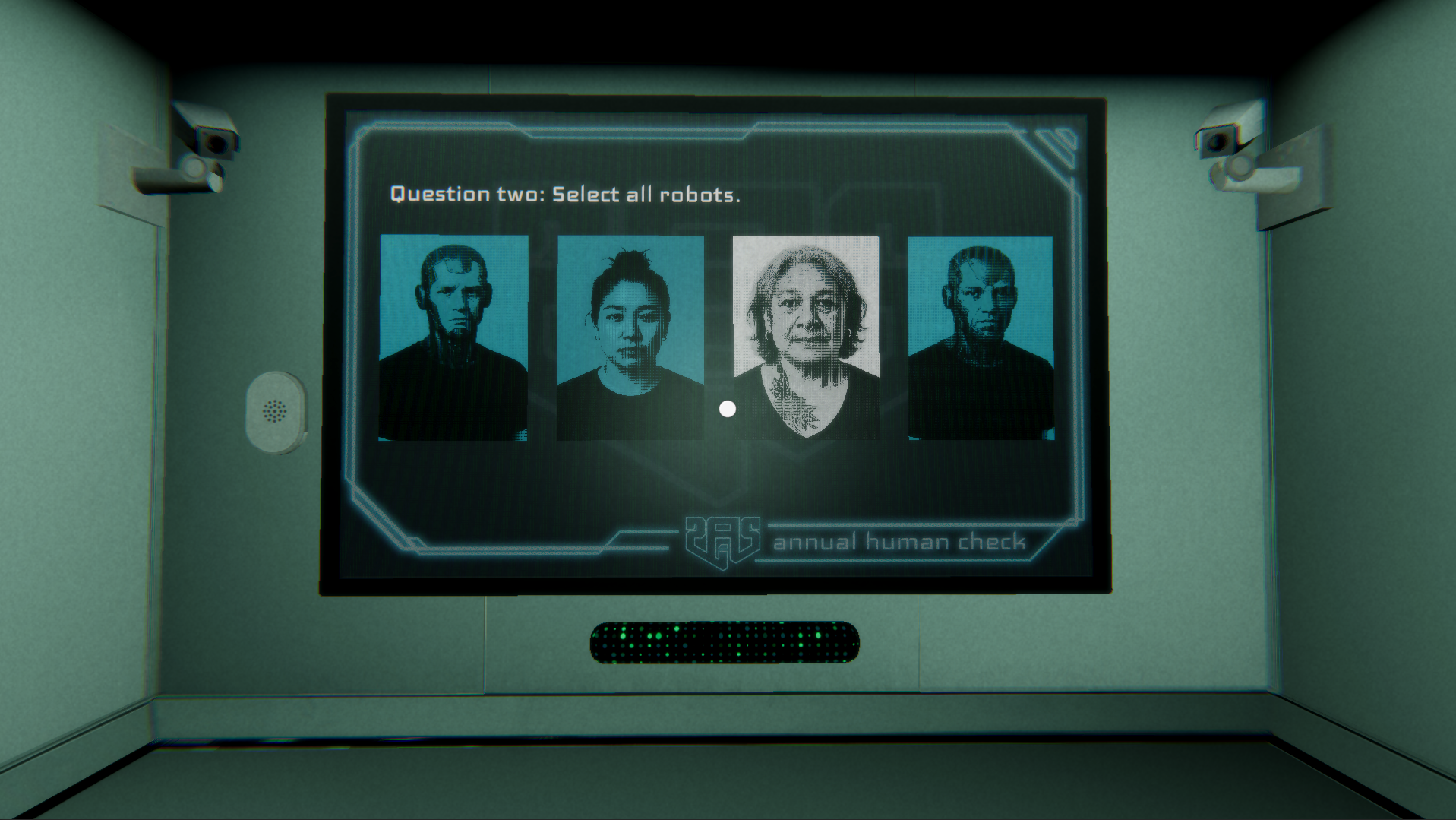
Annual Human Check is a narrative-driven psychological evaluation game set in a sterile, retro-futuristic test lab. Players answer questions prompted by AI-generated images — under time pressure. The game doesn't ask you to win. It asks you to confront your own unconscious biases.
"The premise: an AI is assessing whether you're human. But the real subject of the evaluation is the player themselves."
Made during the Europe Science Game Jam SS2025 around the theme "It's not you, it's me," with an additional focus on bias in games.

Narrative Design & My Role
I led narrative structure for the game — planning the escalation arc from neutral questions to personal to deliberately provocative, so that discomfort builds gradually rather than arriving without context. The tone shifts across three stages, each using a different emotional register to implicate the player more deeply.
Other contributions included the sound design concept — specifically the decision to use a distorted AI voice to reinforce dehumanization — visual concept development with the art team, AI asset generation and curation (with manual post-processing to address visual diversity), and coordinating early prototyping cycles.
.png)
Bias as a Design Tool
Working with AI-generated imagery surfaced an important and uncomfortable tension: the images reproduced social stereotypes in ways the team hadn't anticipated. We chose to address this directly — integrating the stereotypical representations intentionally to draw attention to the biases already embedded in AI systems themselves.
The game became a mirror for both the player and the tools used to make it. That double layer — player bias reflected through AI bias — became one of the strongest conceptual elements of the final work.
.png)
Reflection
Annual Human Check pushed me toward experimental design territory — building not for fun, but for discomfort and reflection. The challenge showed me how unusual games resist clean categorization, and that the most interesting design spaces often live at the edges of existing frameworks.
Games can be genuinely uncomfortable tools for self-examination. Sometimes the right mechanic is the one that makes you pause and question yourself.
.png)