Educational Game · Interactive Installation
ColorQuest
About
ColorQuest is an interactive color-learning game designed for children ages 6–11. Through play, kids discover how colors are created and combined — not through instruction, but through direct, hands-on exploration. The goal: build an intuitive understanding of primary and secondary colors without a single line of text to explain it.
Inspired by Hervé Tullet's Mix It Up, the game presents colors as floating orbs that children select, drag, and physically swipe together to mix. Each successful combination unlocks a new color, rewarding discovery with immediate visual and audio feedback.
ColorQuest was playtested at the TimeLab immersive room at Fraunhofer Institut Berlin, where it was adapted to the space's unique interactive setup.
.png)
Game Mechanics
The core game loop is: Select → Mix → Discover → Reward. The three primary colors (red, yellow, blue) form the base. Mixing them through a swipe-and-press gesture reveals secondary colors (orange, green, purple). Color mixing runs on a Render Target system in Unreal Engine, making the blend process visually transparent and satisfying.
Secondary colors start hidden and are revealed only after a successful mix — progress communicates itself without any extra UI.
.png)
Design & Audio
Visual assets — the color splats — were created from a brush collection refined in Affinity Designer. Voice narration was generated using ElevenLabs, allowing rapid iteration of short, child-friendly prompts directly in the game. Sound effects and music from Envato Assets were chosen to keep the atmosphere calm, friendly, and encouraging.
The UI/UX was prototyped in Figma, then built with Antigravity and iterated with Cursor — aiming for a minimal interface where swiping triggers animation and produces a dynamic color splat, reinforcing the cause-and-effect feeling of real painting.
Pedagogical Approach
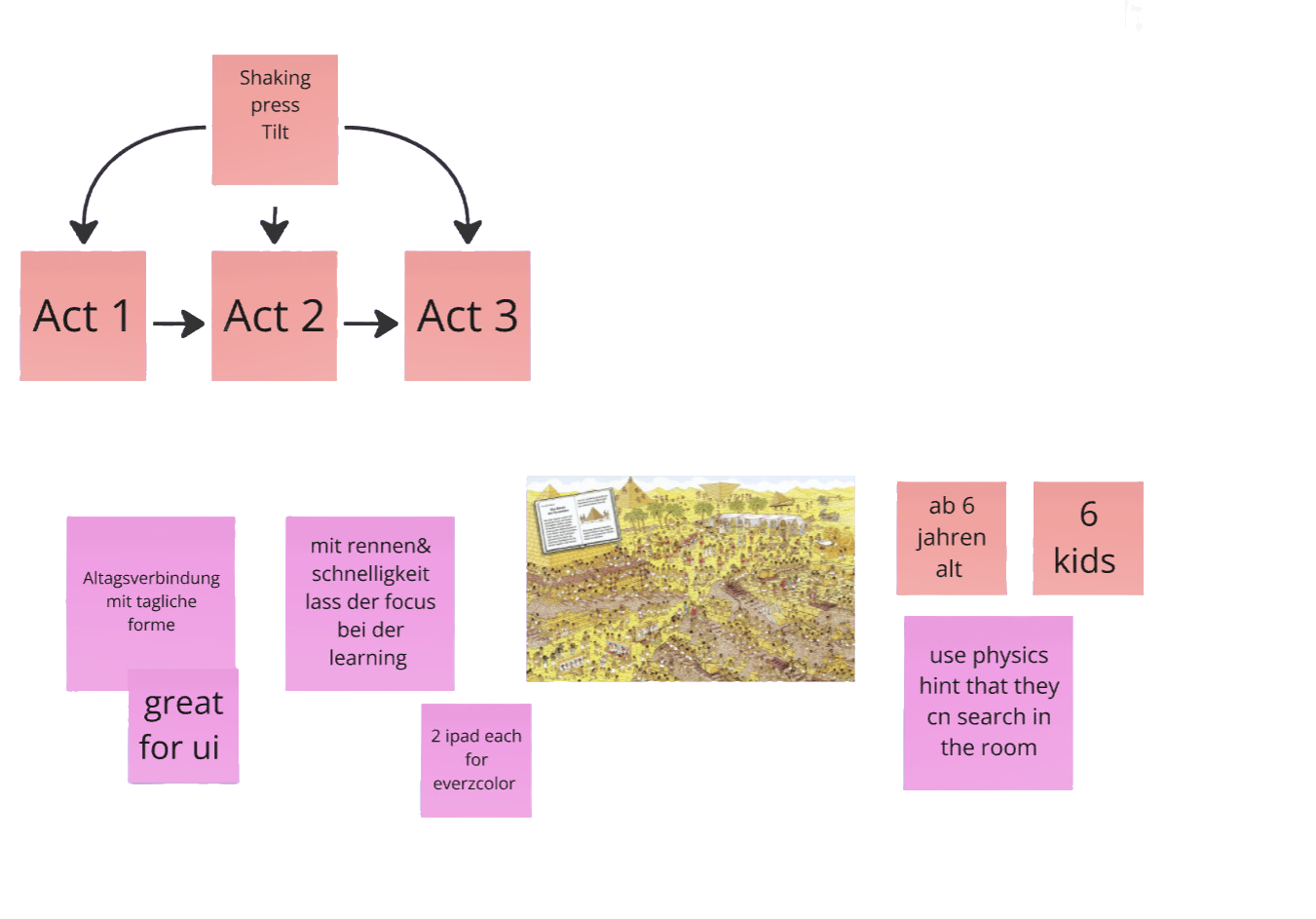
To validate the educational angle, I conducted interviews with a social sciences master's student and ran a broader survey. The design principles that emerged: make successes immediately visible, remove the need for reading, and let the body do the learning. Accessibility was central from the start — future iterations could layer in audio cues and patterns for children with visual impairments.
Key Learnings
ColorQuest deepened my passion for gamification and child-centred design — a space where learning and play become indistinguishable. The project showed me how Render Target logic can make abstract concepts tangible, and how rapid iteration with AI tools (ElevenLabs, Cursor) can dramatically speed up prototyping without sacrificing quality.