★ Workshop · Accessibility in Game Design · A MAZE. Berlin
Playable for Everyone
Why this one
Of everything I run, Playable for Everyone is the format I'm proudest of. It takes accessibility — a topic that usually arrives as a compliance checklist at the end of a project — and turns it into 75 minutes of fast, generative, slightly competitive play. Mixed groups of designers and developers draw cards, frame a problem, and race a constraint toward a demoable idea. Nobody leaves with a "solution." Everyone leaves with a sharper eye.
I built it because the best accessibility conversations I've had never started with guidelines. They started with a concrete player, a concrete moment, and the question "why can't they play this?" The deck is just a machine for manufacturing that question, over and over, at speed.
"the barrier is in the game, not the player"
The one rule. A barrier is something the game demands — not something a player lacks. "The game demands fast reactions," never "the player can't react fast." That single reframing does most of the teaching; the whole workshop is built to keep groups on the right side of it.
Why me. This one really comes out of genuine curiosity — I'm passionate about inclusive design systems, and I keep noticing that the constraints which make a game work for more people tend to make it better for everyone. The workshop is me pointing that curiosity at a real barrier and seeing what a room finds.
The four decks
Each group draws one card from each deck. The unlikelier the combination, the better the ideas.
Player
A concrete person at the controls — one-handed, low-vision, D/deaf, playing on a bright train, short on time. Not a persona, a player.
Game Type
The genre sets the assumptions. A puzzle platformer, a raid, a horror game, a party game — each demands different things by default.
Barrier
Every card names a demand the game is making — color as the only signal, two coordinated hands, critical feedback through audio alone.
Twist
The spark. A constraint on the solution: no menus, better for everyone, subtract don't add, one input only, steal a mechanic from elsewhere.
Run of show
Four rounds, hard-timeboxed. Every transition called out loud — the pressure is part of the push.
Frame it
10 minDraw one card per deck. Write a single sentence and read it aloud. If everyone nods, the frame is honest. If someone frowns, reword it.
Diverge & swap
20 minTen minutes going wide — 10+ ideas on sticky notes, bad ones welcome, no judging. Then the facilitator calls "swap!" and every group trades one card with a neighbour. Keep your notes; let the new card collide with them.
The swap is the engine. It breaks groups out of their first idea and forces the surprising ones.
Converge
20 minPick the single strongest idea and make it demoable: name it (one line), sketch it (one image), play it (a 30-second walkthrough — what does the player do, what does the game do back?).
If they can't demo it in under a minute, it's still too abstract.
Show & steal
20 minTwo minutes per group. After each pitch the room answers one question only: "What would you steal from this for your own work?" No critique — only theft. Every stolen idea goes on a shared Wall of Stolen Ideas.
"What would you steal?" flattens hierarchy and keeps the energy generative.
Close (5 min). Everyone writes one sentence on a card — "The thing I'm taking back to my work is…" — and keeps it. I keep a photo of the wall.
Sample draw
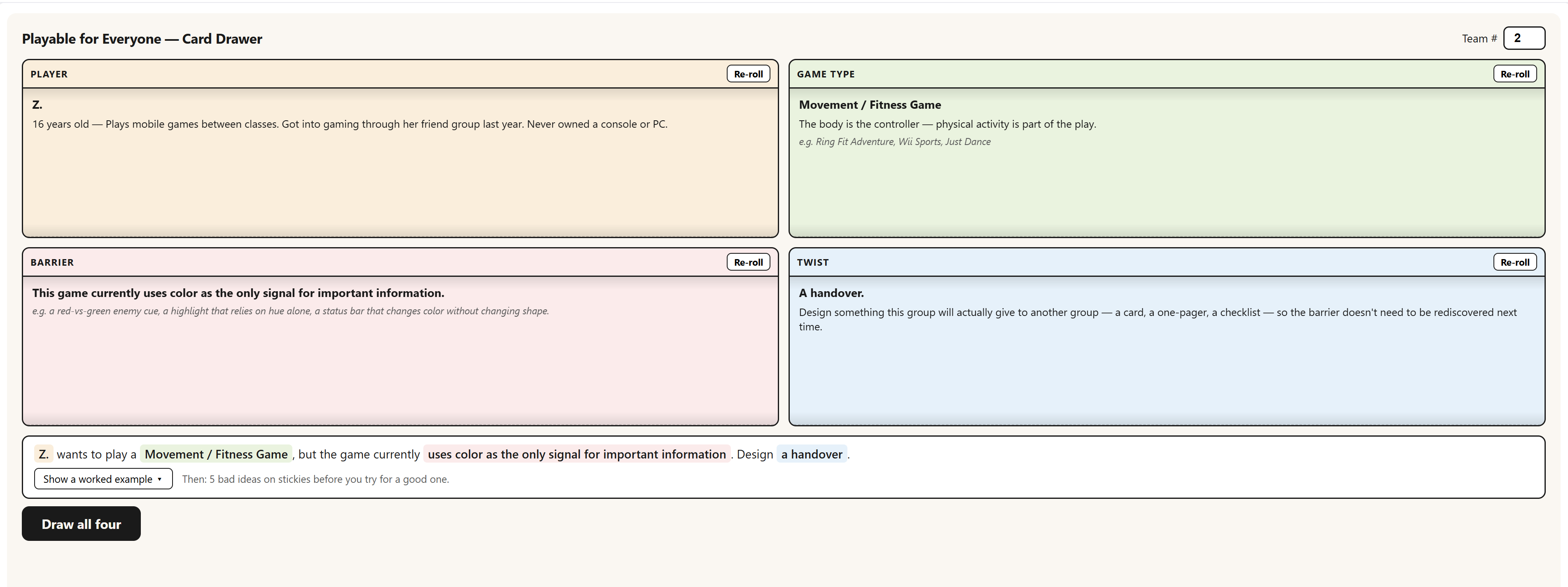
One card from three decks — this is the kind of collision a table works with.
For groups running online, I built a little digital Card Drawer — hit "draw all four" and it deals one card from each deck and assembles the framing sentence automatically, with a re-roll on every card.
The Barrier deck, up close
The revised deck is the part I rewrote most. Every card names a demand the game is making — the footer grounds it in situations where that demand turns into a wall.
Two coordinated hands
The game demands both hands on the controls at once — an attack that needs left-stick plus right-trigger, a menu that only opens while holding a button, a dodge built from simultaneous inputs.
Audio-only feedback
Critical information arrives through sound alone — an enemy you only hear approaching, a puzzle solved by listening, dialogue with no captions.
Precise or fast input
Progress demands frame-perfect timing — a 200ms parry window, a menu that closes if you hesitate, a puzzle timed to the second.
An uninterrupted session
The game assumes you can't be pulled away — no pause in boss fights, no mid-level save, a checkpoint twenty minutes back.
How I facilitate it
The exercise looks light. Holding it well is the actual craft.
Language matters
I walk the room listening for deficit language and reframe it on the spot — "the game demands X," not "the player can't X." That habit is the takeaway.
Protect the Twist
Groups want to drop the Twist the moment it gets hard. That's exactly when it's working. The Twist is the spark — don't route around it.
Mix the table
Every group needs at least two disciplines. Designers alone over-design; developers alone under-invent; mixed groups get unstuck.
No perfect solutions
The goal is the muscle, not the artefact. I say this at the start so nobody freezes trying to be right.
From the board
the Miro board I run it on · tap to zoom inWhat people leave with
Not a finished feature — a reflex. Groups walk out able to spot the demand a game is quietly making, name it without blaming the player, and reach for a solution that makes the game better for everyone in the room. That reflex outlasts any single guideline, and it's why this is the workshop I most like to run.