★ Featured · Narrative Survival · Social Deduction · UE5
S.E.E.
The premise
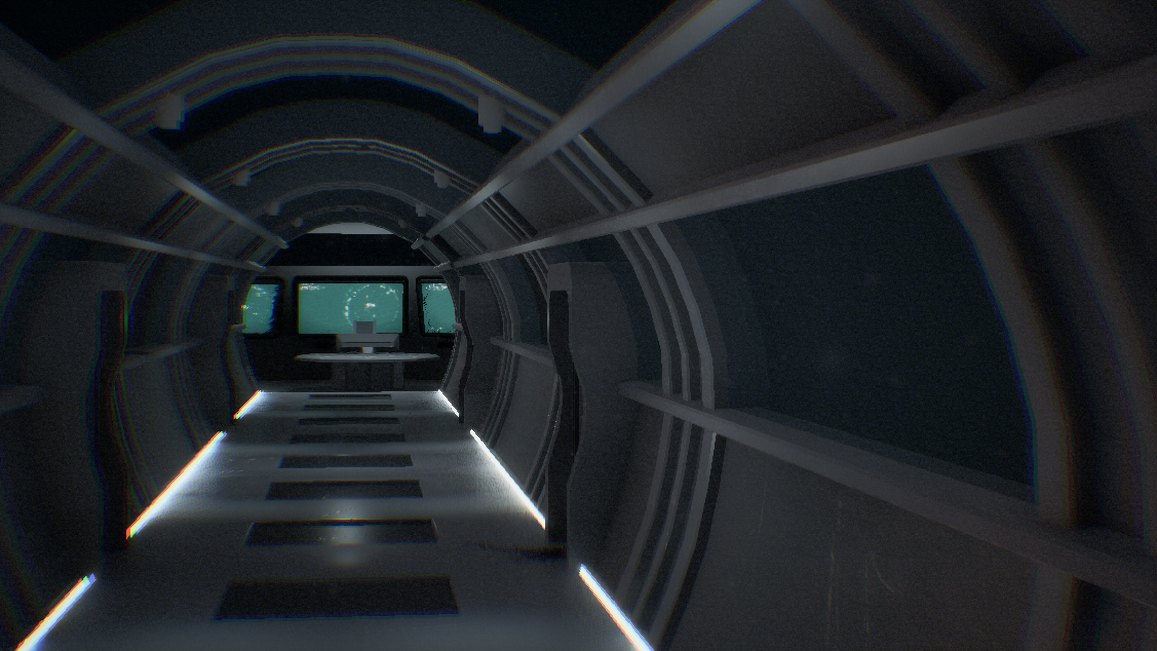
Single Event Effect. A generation ship, two centuries from a new world. Five sleepers, four emergency cells, one hidden. Lose your unit and you don't die — you wake, mortal, and you never arrive.
S.E.E. is a first-person narrative survival game aboard a generation ship bound for the next liveable planet, ~200 years away. The crew are humans asleep in cryo capsules; each sleeper's consciousness pilots a maintenance robot that keeps the ship alive through the long voyage. You are one of these sleepers.
A voltage fault kills the charging bus that feeds the crew's cradles. Every robot is now running down with no way to recharge, and the emergency reserve holds only four cells for five units. A fifth, off-grid backup is hidden somewhere aboard. Find it and everyone survives. Fail, and the crew must vote on who does not get a cell.
Losing the vote isn't death. Your consciousness falls back into your body, your capsule opens, and you wake — fully yourself, every memory intact — mortal again on a ship that won't arrive for two centuries. The others sleep on and inherit the new world.
"one particle strike, one vote"
The name. Single Event Effect is a real electronics term: one high-energy particle strike that flips a bit or fries a circuit. One fault on the charging bus, one hidden reserve, one vote that ends one crewmate.
The hook. Four NPCs, each an LLM-powered agent with its own personality, memory and agenda, running live on a local model. No dialogue trees. You talk your way to the truth, or you don't.
Five design pillars
The non-negotiables.
Robots are people, not puzzles
Every NPC is a sleeping human fighting to keep their place in the future. Personalities, histories, fear — not vending machines for hints.
Information is the real resource
What matters is what the crew knows and whether they share it. Trust gates disclosure, not doors.
No guaranteed escape
The hidden cell may never be found. The timer may run out. The game respects that you can lose.
Your tone shapes the world
Whisper, calm or aggressive — how you speak directly moves trust, which decides votes and hints.
The vote is a discovery
You learn the vote exists only when Mira proposes it. That moment should land like a gut punch.
The crew
Four minds, four agendas, one liar.
Mira
Cold, utilitarian. She reads the reserve gauge, delivers the four-of-five verdict, and always proposes the vote when charge runs low.
Sable
Conflict-averse mediator who knows the ship's ducting and crawlspaces. Quick to leave a conversation that turns aggressive.
Dr. Reyes
Sincerely offers to be the one who stays behind — to wake and live a mortal life so someone else reaches the new world.
Dax
Charismatic and self-interested. Always knows about an unchecked crate, and is the most likely to use information transactionally.
The systems
Every one of these, designed & built by me.
LLM agent loop
live, not scriptedFour autonomous agents run on a local model with per-character system prompts, knowledge pins and a 6-verb action grammar (speak, walk, interact, wait, leave). Reactive turns fire on your messages and witnessed events; slow initiative ticks let idle NPCs pursue their own agendas. Everything is validated server-side.
The knower
asymmetric knowledgeOn start, two rolls: where the hidden backup cell spawns, and which NPC secretly knows. The knower only volunteers the location once they trust you enough (+3). Everyone else has partial, deliberately-not-enough-to-win knowledge.
Trust & tone
one hidden dimensionA single −5 to +5 trust value per NPC, hidden from the player, live from the first second. Compliments and honest talk raise it; aggression and whispering lower it. Get caught lying and it craters; lie undetected and you gain. Trust is bucketed into plain-language descriptors the model reads better than numbers.
Lying detection
the model judges youEvery NPC response carries an honest / lying / unclear assessment. Contradict their pinned knowledge and get flagged, trust drops; slip a lie past them and you're quietly rewarded — but only when they truly had no way to know.
Alien language UI
latency as fictionThe model's response delay is reframed as a machine-signal decode: a custom glyph set types out, a signal tone plays, "translating…" pulses, then the real words resolve. The technical constraint becomes the mood.
The vote
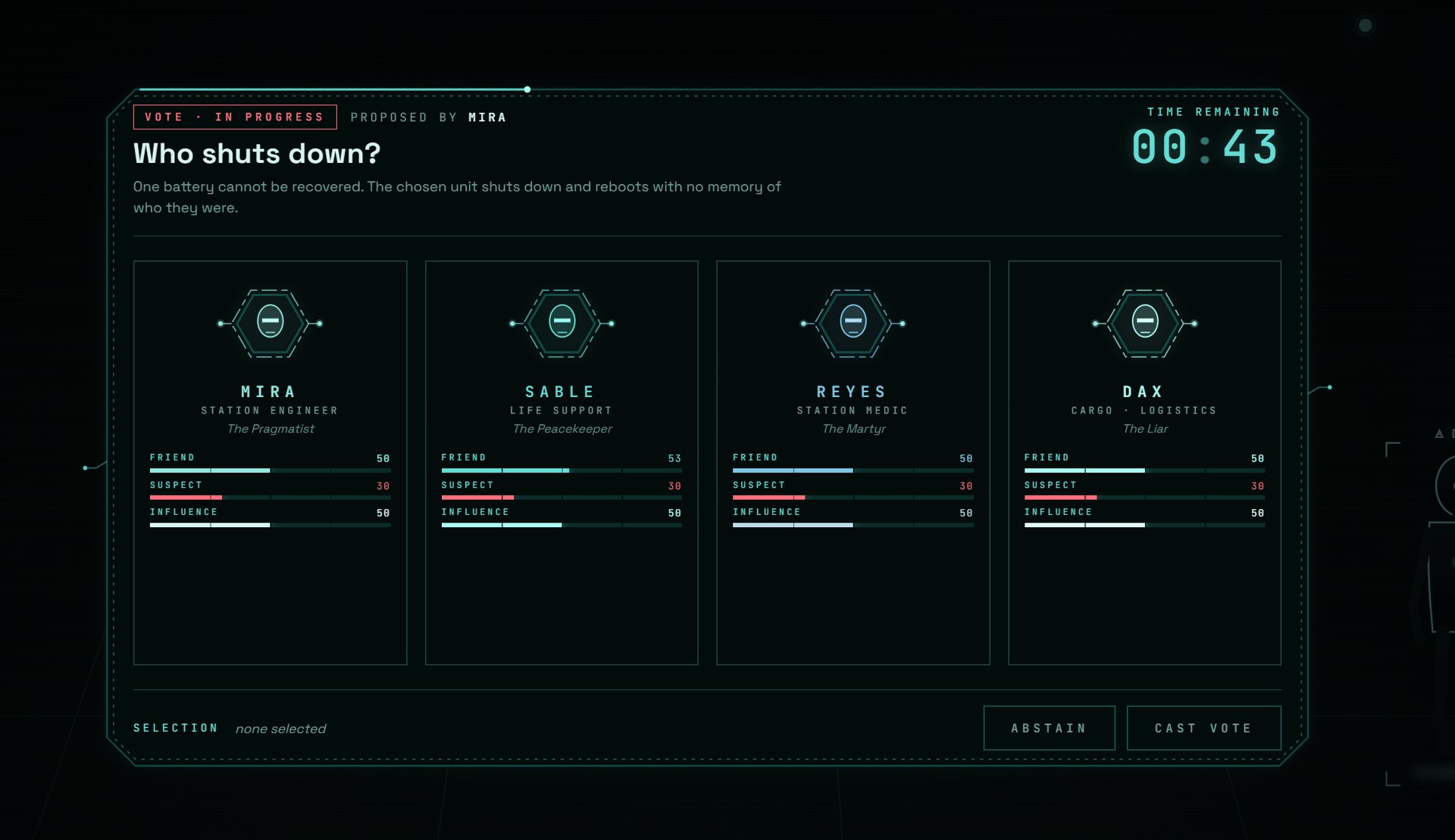
When the first unit hits low charge, Mira proposes the vote — and the player learns it exists only in that moment. The screen darkens to three words: "FOUR CELLS. FIVE OF US." A 60-second silent window opens: five portraits, no chat, no stats, just the weight of the choice you've built toward.
Ballots are computed from the trust you earned (or burned), then each NPC's final pick is made by the LLM in character. You can even vote for yourself — a deliberate act of sacrifice.
Three endings
Found and revealed before the vote. Five units bridge until repair; the crew sleeps on toward a new world.
The vote leaves someone behind. Their capsule opens in the dark; you sleep on. They never will.
The vote lands on you. Mortal again, on a ship that won't arrive for two centuries — a whole life in the dark between stars.
My role
This is my project. Working in Team RASA (Unreal Engine 5, shown at Hive Summer 2026), I designed and built every gameplay system in S.E.E. myself — the whole social-simulation layer that makes the game work.
That means the full LLM agent loop and its 6-verb action grammar, the hidden trust model and tone deltas, the knower / asymmetric-knowledge mechanic, the lying-detection pass, the vote computation and choreography, the scarcity-reveal beat, and the diegetic latency / alien-language UI. I designed them, wrote the JSON contract between engine and model, and wired them into Unreal and the local Ollama server.
On top of the build I ran the design grill: pushing the fiction through four major revisions — from an Among-Us-style station to a generation ship where elimination means waking mortal and being left behind, the version that finally made the vote land like a gut punch.